Monday, January 7, 2019

But It Is (Poem and Picture 020)--January 6, 2019


But It Is
See Christ Here Poem and Picture--January 6, 2019

I do not know
what bright celestial object
those wandering Magi followed
to lead them to see
that Christ was real.
But I know what it is
to glimpse the way
the setting sun
lights up the clouds
and to know the world
did not have to be
so full of beauty.
But it is.


#seeChristhere


Human Lessons


Human Lessons--January 7, 2018

"Let each of you look not to your own interests, but to the interests of others. Let the same mind be in you that was in Christ Jesus, 
   who, though he was in the form of God,
       did not regard equality with God
       as something to be exploited,
   but emptied himself,
       taking the form of a slave,
       being born in human likeness." [Philippians 2:5-7]

I sometimes think that the hardest part of the Christian faith isn't the mind-boggling doctrine that Jesus reveals the very nature of God, but rather the uncomfortable truth that Jesus has to show us how to be human, too.

Divinity, after all, is mysterious and distant and infinite and eternal--we expect it to be beyond our paygrade.  We assume that we would need some additional guidance from an expert to understand what God is like.  But being human?  That is literally our job.  That is--or at least it should be--our bread and butter, our most basic fundamental proficiency.  Being human should be, should be, right in our wheelhouse.  

And yet, if we are really honest with ourselves, we'll admit that we are not terribly good at this thing called humanity, and we really do need someone to teach us collectively how to be fully what we were meant to be.  We need, for lack of a better term, human lessons.  

In addition to revealing what the very face of God is like, Jesus gives us the fullest sense of what it really means to be human.  That's here at the core of these words from Paul's letter to the Philippians, words which Paul is likely quoting from an even earlier hymn source. Jesus shows us what it really means to be human.  And if our way of being human runs counter to Jesus' way of being human, we are missing something important.  That's why Paul can say so bluntly and directly, "Let the same mind be in you that was in Christ Jesus."  In other words, "If you want to know what it looks like to be fully human, start living and thinking, speaking and acting, in ways that echo what we saw and know from Jesus."  Jesus is the teacher of this course in humanity, even if we already think we are experts on the subject.

So what does Jesus have to show us about our own humanity?  What do we have to learn about how to be fully human?  When Paul thinks about it, he puts it in simple terms: others first.  Jesus shows us how to be fully human, not with elaborate displays of religiosity, feats of physical strength, intellectual argumentation, or silent meditation, but in the actual lived practice of putting others' interests before our own.  Paul doesn't see this as a "special" quality of Jesus, reserved only for messiahs or prophets, but basic humanity for all, and essential for all of us in how to truly be human.  

That means, too, that in the moments and situations where we refuse to consider the interests of others as more important than our own, we will be failing to be fully ourselves, fully human.  Where we shout loudly, "Me and My Group First," we are not modeling true greatness at all, but in fact we are revealing how empty and deficient our humanity is.  We were not made to look out simply for ourselves.  We were not made to do it, as the old song puts it, "my way."  We were made for putting others first, as they are also made for doing the same for us in a living, flowing, vital community.  

This is a really important point to be clear about, because sometimes we religious folk seem to think that we are supposed to put others first as a way of impressing God or earning ourselves some "heaven points."  You'll hear folks sometimes talk about being good or being selfless in order to get themselves a "crown" in heaven. But that's not at all how Paul sees it.  The reason to care for the interests of others is not as a means toward some other reward.  The reason to put others first is not so that they'll "owe" us and one day we'll be able to cash in on favors.  We are called to put the interests of others before our own because that is how Jesus shows us how to be human.  To put myself first--my wants, my security, my personal wish-list--misses the point of what we are made to be.

Jesus comes into human history, as human as you and me, not only to bring us face to face with God, but to give us at last a clear picture of ourselves--to show us what it means to be really and fully human.  He doesn't come with an angry look and a furrowed brow to say that if we aren't well-behaved enough we will lose our heaven points and get kicked out of the club--he comes to show us what we were made to be, how we were made to give ourselves away, and how we were made for being filled back up again by the living God in one great, never-ending flow.

One of the things the New Testament writers are absolutely clear on is that Jesus is what it looks like for God to take on humanity.  That is what makes the Good News possible--that God has entered into our existence, that God has embraced us as we are, and that God goes all the way with us even to human death on a cross to save us.  And at the same time, that also means that Jesus shows us what being human was really all about all along, and he offers us the way to be pulled out of our self-centered, Me-First misery, to be fully what we were meant to be all along.

Listen today for the voice of Jesus.  Look today for the way of Jesus.  In the ways Jesus put others before his own needs and interests, Jesus hasn't done anything beyond our ability--in fact, he is showing us precisely what we were meant for in the first place.

Lord Jesus, you who came among us as one of us, give us the ability to live in the freedom of being for others, and to find what we were meant to be all along.


Saturday, January 5, 2019

It Is A Risk (Poem and Picture 019)--January 5, 2019


"It Is A Risk"
See Christ Here Poem and Picture--January 5, 2019

Here
is my rough-edged
frozen
beautiful
heart.
I found it
resting
in the trash
and could not leave it there.
It is a risk
to a heart of ice
to let yourself be held
in someone else's warm hands.
Being held
means embracing the danger.
God's wounded hands
are safe.
#seeChristhere


Friday, January 4, 2019

Incarnation Again (Poem and Picture 018)--January 4, 2019


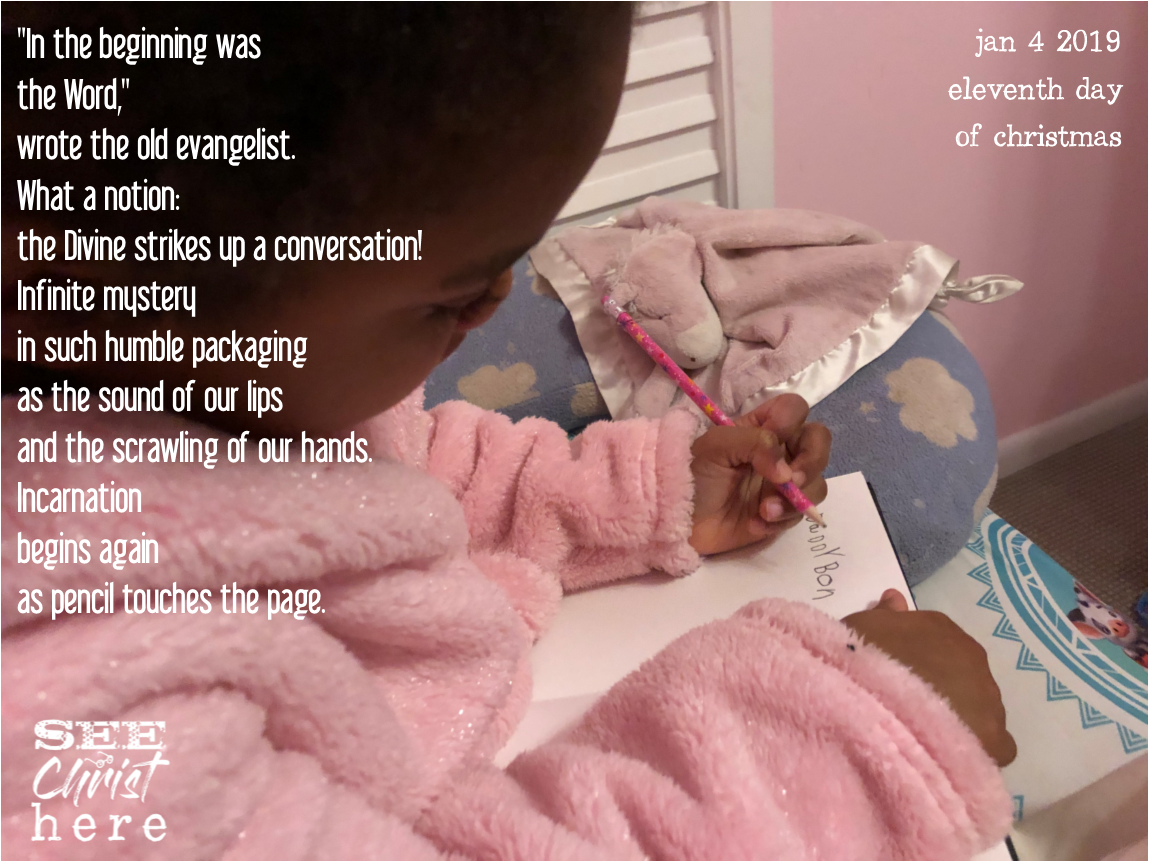
Incarnation Again
See Christ Here Poem and Picture 018--January 4, 2019

"In the beginning was
the Word,"
wrote the old evangelist.
What a notion:
the Divine strikes up a conversation!
Infinite mystery
in such humble packaging
as the sound of our lips
and the scrawling of our hands.
Incarnation
begins again
as pencil touches the page.

#seeChristhere


Thursday, January 3, 2019

The Pigeons in the Temple


The Pigeons in the Temple--January 4, 2010

"When the time came for their purification according to the law of Moses, they brought [Jesus] up to Jerusalem to present him to the Lord (as it is written in the law of the Lord, "Every firstborn male shall be designated as holy to the Lord"), and they offered a sacrifice according to what is stated in the law of the Lord, 'a pair of turtledoves or two young pigeons'." [Luke 2:22-24]

Jesus was poor. And he came from a poor family. 

(He also never owned a house and lived much of his adult life dependent on the monetary support of several women who traveled in his group of disciples, too, while we are on the subject.)

Part of how you know that Jesus was poor, even from childhood, is the way Luke recites the offering his parents provided when he was presented in the temple as a baby.  Luke notes that "the law of Moses" directed them to sacrifice "a pair of turtledoves or two young pigeons," and that is true.  But the whole picture is this: the Torah commanded people to offer a lamb on the occasion of the birth of a firstborn... except for those who could not afford one.  If you couldn't afford a lamb, the law said to offer the pigeons (and, interestingly enough, there was even another option for those who couldn't afford the birds--a scoop of flour or grain). So, let's put two and two together here: the poor were the ones who were allowed to offer the turtledoves... and Jesus' parents gave the turtledoves. The pigeons in the Temple story are Luke's way of subtly reminding us that Jesus--the Son of God incarnate and the Savior of the world whose birth is Good News for all people--came from a family that was on the Israelite version of public assistance.  

Jesus would have gotten free lunch at school if he had gone to the same public school where my kids go.  Breakfast, probably, too. They might have even sent him home with a backpack full of food for the weekends, for that matter.  Jesus' family was too poor to afford the "full pay" rate for the sacrifice celebrating the birth of their firstborn son, not to mention the very Messiah of God.  And Luke doesn't blush about telling us, nor does Mary seem to be embarrassed about her circumstances, either.  The Creator of the universe was born to a family that struggled to make ends meet.

It is worth letting that sink in for a minute, especially these days, because there are a lot of loud voices--and shamefully, I have heard a number of them from the Respectable Religious Crowd who think they speak for this same Christ--who make claims like, "a poor person never gave anybody charity, not of any real volume." You know the rest of that train of thought--it is so tired and cliché we could all recite it by rote: the real difference-makers are the ones who make us richer, and so you can judge a society, a culture, a nation by how rich it makes people.. and the people who don't make enough must be lazy, or unambitious, or deficient in talent.  And of course, all of this gets said with a cross pin on the lapel and the insistence that God is endorsing all of it.

Well, not to put too fine a point on it, but it would seem that Luke here insists that this whole train of thought is a load of dingoes' kidneys.  Not only was God's Messiah born to a poor family--and stayed poor all his life--but he was on a form of public assistance  that had been built into the regulations and laws of Israel meant to help out mothers and fathers who didn't make enough to pay all their obligations.  And not only was this the face of the Messiah at birth, but it is precisely in this poverty that this Jesus offers the greatest act of charity in all of history, a gift of infinite worth and immeasurable and real "volume."  In fact, that is the very claim the New Testament would later make about God's coming to us in Christ:  "You know the generous act of our Lord Jesus Christ, that though he was rich, yet for your sakes he became poor, so that by his poverty you might become rich" (2 Cor. 8:9).  At the heart of the Christian faith is the claim that God didn't just take a pleasure cruise to rub elbows with the upper crust, but was born among the marginalized.  And to be clear, the Scriptures see this as essential to the way Jesus saves.  A god who just takes a summer holiday at some exclusive tropical resort isn't there to help anybody--that's just a cosmic tourist of a deity.  But a God who identifies with the ones that the world has called "nobodies"... now that is powerful.  That is at the heart of what real charity--which was always meant to be another word for love--is all about.  That's what grace looks like.

We have a way of looking down on folks with less, and looking for ways to villainize them--we want to make ourselves feel superior by looking down on people whose paychecks are smaller, or who don't have as good insurance as you might have, or who have qualified for public assistance.  We religious folk--and I say this to our shame--have this myth we tell that God is disappointed with "those people" because they don't earn as much, or because they admit that they need the help of others, or because we  imagine they must be lazy or unmotivated.  We are quick to assume that "they must use drugs," or "they must be wasting their income on extravagances they can't really afford," or "they must sit around all day doing nothing", because deep down, we need someone we can be better than in order to make ourselves feel acceptable.  That is the terrible (and idiotic, while we are at it) logic of thinking that the only way to make yourself feel better is to push someone else down; it is always faulty logic, but it is still terribly popular and tempting in this day and age.

But before any of us Respectable Religious people decides to write off "those poor people" as all lazy or immoral or parasitic, we should be clear about who it is we are vilifying: his name is Jesus, and his mom and dad got help to cover the costs even for the sacrificial celebration meal when he was born.  The pigeons in the temple are a sign that the Christ of God was born on public assistance, and it is precisely because of that that the infinite riches of grace are yours.

Lord Jesus, thank you for coming among us as one of us. Keep us from trying to push ourselves up by looking down at others.  And give us the vision to see your blessing on the poor as the sign of your Reign taking shape among us.


Wednesday, January 2, 2019

God in the Caravan


God in the Caravan--January 3, 2019

"And the Word became flesh and lived among us, and we have seen his glory, the glory as of a father's only son, full of grace and truth." [John 1:14]

God knows what it is to live tenuously in a tent city.

God knows what it is to dwell among people unsure of whether there will be a home for them waiting in the new land in front of them, and afraid of the terror they have left behind. 

God knows the life of the caravan; God has been there.

That is exactly what John is saying here in the opening chapter of the gospel we call by his name: that the living God has pitched the divine tent with us, with humanity, in the life of Jesus, much like God had done dwelling with the freed Hebrew slaves living in tent cities in the wilderness between the hoped-for Promised Land and the dangers of Egypt where Pharaoh made them fear for their lives.

When John says, famously that "the Word became flesh and lived among us," the word he uses that gets translated "lived" is really more literally "pitched a tent" or "camped out" or "tabernacled" with us, like the old tent of meeting where God and the people met while they wandered through the wilderness in the Exodus journey.  Quite literally, John says that in Christ's coming in the embodied flesh of Jesus, God was "camped out" with us, with all of humankind.

But to be clear here, the scene isn't like a fun weekend camping trip, or like that time when you were eight and set up your tent in the back yard on a summer evening.  This is long-haul living in a tent-city, not a fun day or two in the woods before you return to the creature comforts of running water and electricity in your house.  Most of us--at least among you who are reading this and me as I write--most of us haven't spent long, extended time living in a tent, I'll bet.

You might well love camping. You might well go hiking all over creation.  You might have been spending time in a tent from your toddler years all the way up through taking your kids and grandkids camping.  But for us, most of the time, it is a temporary arrangement.  It's a bit of fun precisely because it's a temporary escape, and we know full well that whenever we feel like it, we can take the tent down, pack up our belongings, and go back to a safe and comfortable home.  That's not the picture that John has in mind.  

No, John is picturing the decades-long wandering in the wilderness by the people of Israel, living in mobile tents as they wound their way through the deserted spaces between Egypt behind and Canaan before them.  And all throughout that journey, God symbolically dwelt with the people, right in their midst, throwing in all of God's chips, so to speak, on making the journey with them.  Now, everybody knew back in those wilderness days that God didn't really just live "inside" the tent, but it was meant to be an image, an illustration, a visible and tangible symbol of God's willingness to cast the divine lot with these people against all odds.  That journey wasn't a weekend at the local state park, or a night in the back yard with fireflies; it was an uncertain and open-ended trek which became a way of life. The wilderness wanderings were a time in Israel's history when they were forced to leave their old home (where they had lived in Egypt for centuries, as the Scriptures tell it) only on the hope that they would be able to make new homes in a new land, simply on the promise they had handed down from one generation to the next.  And all along the way, while fleeing from the government of their old country and waiting at last to arrive in their new land, the people lived in temporary camps of tent cities, moving in a caravan from Egypt to the Promised Land.  So, as the Scriptures tell it, God set up a tent there with them, too, for the whole journey. As long as it would take.

And that scene--of God coming "down" to live in a tent along with the Israelites--is what John has in mind when he says that in Christ, God "camped out" or "set up a tent" to live among us.  God's coming to be with humanity in Jesus is the ultimate expression of the same solidarity God had shown by living in the tent city of the wandering Hebrews.  It is a sign of God going "all in" to be with us, on the "side" of all humanity, enduring the dangers of the wilderness with us, as one of us, for as long as it takes.

So my mental picture is going to have to change here. Instead of picturing the coming of Christ like God taking a fun holiday or making a weekend camping trip to visit humanity, the image John has in mind is of God setting up a tent in the midst of our wandering caravan, living with us on the journey of life.  And John says that is what the Christian faith is all about: a God who, in Christ, chooses to throw all of his chips in with humanity by setting up a tent in our camp, just as God had done by joining the caravan of migrant Israelites leaving Egypt for Canaan generations before Jesus.  

If we are going to understand what it means to see Christ here, in our humanity, in a manger, and in the person of Jesus of Nazareth, then we are going to need to get our scene straight: God doesn't just "drop in" to visit humanity on a whim for fun, but chooses to dwell among us on the long caravan we call life.  If you ask John, there is no other God besides the One who camped out in the caravan of migrant Israelites fleeing Pharaoh, the same God who in Jesus set up a tent in our refugee camp to "dwell" with us on the journey we are all making called life.  Any deity who cannot stomach life in a tent city is a fraud.  

This, friends, is the Lord of the universe.  This is the One about whom we sing, "Oh come, let us adore him"--the God who "camped out" with us permanently in Christ, who has been dwelling in tent cities and caravans with fearful refugees since the days of Moses.  This is the One on whom we call today.

Lord God, give us the eyes to recognize you dwelling among us, and to hear with fresh urgency the stories of your camping out with your people as they fled Pharaoh and sought refuge in the land of your promise.  Teach us to recognize your presence there, and here among all who seek refuge today, too.

Tuesday, January 1, 2019

The Stark Benediction


The Stark Benediction--January 2, 2018

"And the child's father and mother were amazed at what was being said about him. Then Simeon blessed them and said to his mother Mary, 'This child is destined for the falling and the rising of many in Israel, and to be a sign that will be opposed so that the inner thoughts of many will be revealed--and a sword will pierce your own soul too." [Luke 2:33-35]

Usually, if people ask you to give a blessing, they are asking you to say something... nice.

Vague, too, probably.  Keep it flowery, keep it light, and keep it upbeat.  Don't dwell on specifics--those are too hard to fact-check later to see if they came true or not. And don't open up any cans of worms with bad news, danger, or controversy.  Keep it bland but poetic, harmless but memorable.  You know, like the inside of a greeting card.

Consider this a bit of inside information from someone whose work life often involves requests for the "religious professional" to "give a blessing" at this or that civic function, family birthday party, high school graduation, or national holiday.  When folks ask their local preacher, pastor, or chaplain to give a blessing, they usually want a verbal lucky charm punctuated with the sign of the cross at the end--nothing that will change or challenge anybody.

And, look--I get it.  At those happy moments of life, we all want to just feel pleasant.  We want people to say, "Wasn't that nice?"  We want to show our friends, neighbors, and guests that we are religious--hence asking for someone to "give a blessing" in the first place.  We want our local family-affiliated religious professional to talk, but we really don't want them to say anything.  Just get to the "Amen," and we can get on with the cutting of the cake or the cutting of the ribbon.

In fairness, look what happens when you don't follow that prescription--you get Simeon's strange and unsettling blessing of the child Jesus and his parents.  And, unquestionably, it is a stark benediction.  There's no rhetorical flourish, no flowery poetry, and no harmlessly happy inspirational fluff.  There is only a sense of divine purpose that will bring change--change to the child Simeon holds in his arms, change for Mary and Joseph, change for the powerful and the lowly, and change for the whole world.

If we are paying attention, this should probably unsettle us.  We don't like the idea of a blessing that could provoke change in us or our world.  We don't like the idea of a benediction that pokes us awake as much as it comforts us.  We don't anybody telling us that God will change us--we want God's stamp of approval  on the status quo. We would ask Simeon to invoke the Almighty to leave us and our comfortable routines alone, to let our familiar arrangements stay just as they are, to preserve and protect the stability and order of life-as-we-know-it.  And Simeon does... well, just the opposite.

But that doesn't mean he is bad at blessing, or that this is a "wrong" benediction.  It means, if we are uncomfortable with this scene (and I have to be honest with you, I can't recall anybody preaching on this passage in my childhood or early adulthood--always easier to punt on the Sunday after Christmas), we are not very good at letting God call the shots when blessing us.  We tend to think that "blessing" is like consulting a genie or a lucky clover--that it is a quasi-magical power we can use at our discretion to accomplish our own goals.  But God has a way of blessing us that looks less like the granting of wishes, and more like suiting us for God's good purposes.  And that sometimes means God blesses us in stark and challenging ways that surprise us, challenge us, stretch us, and change us.  Jacob, after all, gets punched in the hip as God blesses him--the benediction of God leaves him walking with a limp for the rest of his life!  And for that matter, Jesus only blesses the bread he breaks, so that it can be given and shared with all. A punch in the pelvis or the tearing of bread--that's more like what genuine blessing does.

That's the force of Simeon's blessing, too.  The Christ child whom he blesses will be the cause of change for many--the "falling and the rising" of many in Israel, and the unmasking of the hypocrisy of the Respectable Religious Crowd.  That had to be hard for Mary to hear, even if she knew that was exactly what the world needed from her son.  You want to hear things like, "I just know your child will be on the honor roll one day, the captain of the football team, or the homecoming queen!  I just know your child will be successful in business and happy in family life!"  And Simeon doesn't do that sort of vaguely "nice" blessing.  He insists that the Christ child will change things--just as Mary had sung about in her pregnancy: bringing down the powerful from their thrones, feeding the hungry with good things, and sending the rich away empty.  Simeon's blessing questions the status quo, and to him, it is good news that the child in front of him will overturn the old order and pull away the masks and pretense of the arrogant and the proud.  But it is a stark blessing all the same.

Simeon knows, too, that all of this change will be met with hostility and opposition.  Nobody wants to have their comfortable world changed, and absolutely nobody wants to hear that God is the one doing the changing. But if the Christ has come to set things right, it will mean that everybody invested in "the way things are" will find Jesus to be dangerous, provocative, and subversive.  They will oppose any changes to their order.  They will start looking for hammers and nails.  Simeon knows that--there is already the specter of suffering and the shadow of a cross cast over this child and his mother from the very beginning of his life.  That, too, is part of his blessing.

So here is the question for us today, just two days into a new year: do we dare to let this same God on whom Simeon called bless us, too?  Do we dare risk the possibility of a stark benediction over us as well, even if it means that the God who blesses us sends us out in to the world like Christ, both to lift up and to pull down, to risk being criticized or rejected, to be changed and challenged and poked out of complacency?  Are we willing to let genuine blessing unsettle us and light a fire in our bones, not simply to endorse our creature comforts and white-picket fence lives, but to conscript us into service in the Reign of God where the lowly are lifted up and the powerful and proud are pulled down?  Are we willing to let the living God rearrange our priorities, our pocketbooks, our privilege?  Because all of that comes along with real, living, breathing blessing, and not just the vaguely inspirational tripe mouthed by a rent-a-preacher.  

If we dare to be blessed in such an authentic way, we can be certain about two things: one, we will be blessed the same way the Christ child is blessed--in order to change the world; and two, we and the world to which we are sent will never be the same.

Be blessed, dear ones.  Be blessed, people of Christ.

Lord Jesus, bless us and stake your claim on us--not to get your endorsement on our wish-lists, but to submit and reshape our wishes, wants, and well-being in light of your Reign of justice and mercy.